
On Futarchy
Sequel of sorts to The Price of Truth. Credits to 01Resolved, lbolord on Twitter, Blockworks Research, and Mauboussin/Callahan's Morgan Stanley report on the Wisdom of Crowds in Markets.
Disclosure: I own META, bought on the open market. Nothing on this site is financial advice.
In February I published The Price of Truth, an essay about why markets are truth machines. Hayek explained why prices work: the knowledge an economy runs on is scattered across millions of minds and can't be collected, so the price does the collecting. Taleb explained why prices stay honest: skin in the game and ruin quietly remove everyone who is consistently wrong. I ended the essay on prediction markets but left something unfinished.
A prediction market primarily does forecasting. Its participants bet real money on outcomes, which is why it often beats panels of experts who don't. But once it has priced an outcome, its job ends. The actual decision still gets made somewhere else, by a board or a foundation or a token vote, some of which have very little at stake in the first place.
But what if prediction market outcomes, and the stakes involved, were also part of the decision making process itself?
Futarchy, coined by Robin Hanson in 2000, is the answer to that question. And an experiment in it is running right under our eyes, one that happens to bear on a problem that has plagued traditional venture capitalists and investors in the most speculative asset class of today alike. MetaDAO, the project where futarchy runs in production, is what I will be examining for the rest of this essay, first as a mechanism, then as an asset.
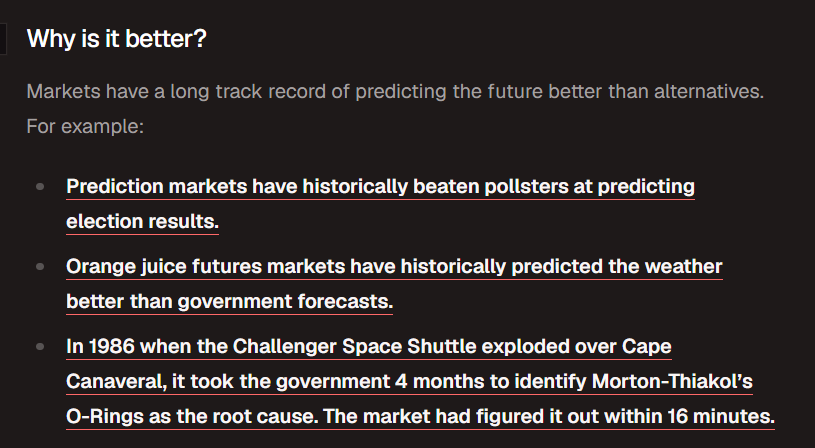
Vote on Values, Bet on Beliefs
Futarchy was initially designed for nations. Democracy keeps the job of saying what we want, through elected representatives who define and manage a measure of national welfare, and betting markets take over the question of how to get it. The basic rule of government: a policy becomes law when the market clearly expects it to raise the welfare measure. Hanson rested this on three assumptions:
- Democracies fail largely because they fail to aggregate the information their citizens already hold.
- It is not hard to tell rich, happy nations from poor, miserable ones.
- Betting markets are the best institution we know for aggregating information.
The design is deliberately neutral; it could deliver anything from extreme socialism to extreme minarchy, depending on what voters want and what speculators think gets it for them.
No nation has run the experiment, and part of the reason is the metric. In Hanson's version, voters still have to choose and maintain the measure of welfare, GDP or something like it, and that choice is a political fight in its own right.
A token dissolves the fight, because governance and the economic claim are fused into one tradeable instrument: the thing you govern with is the thing you own. The metric for success is now tied to the value of the token. Crypto, thus, is the asset class where decision markets found their first working home in more than two decades. So how do decision markets actually work inside a crypto asset? This is where MetaDAO comes in.
MetaDAO
MetaDAO is a launchpad for early-stage startups, and the difference from an ordinary one is where the money goes afterwards. A raise runs for 4 days, everyone commits USDC, and everyone pays the same price per token, funds and retail alike. When it succeeds, the proceeds don't go to the founder. They go into a treasury governed by markets, along with the authority to mint new tokens and the project's IP, the domains, the social accounts, the software itself. The team draws a fixed monthly budget; anything bigger requires a proposal.
What follows applies to every token launched this way, and equally to META, MetaDAO's own token, which is governed by the same machinery. A proposal is code that executes if it passes. No signer can decline it, and there is no governance forum; people argue on X and Telegram, but the venue that decides is the market. Opening one takes a stake of about 2% of supply. Half the token's spot liquidity then moves into two conditional markets, the token if the proposal passes and the token if it fails, and for 3 days anyone can trade either world. Settlement happens only in the world that arrives.
Resolution uses a time-weighted average across the window instead of a closing price someone could manipulate. The average is lagged and movement-capped, so a wild print only drags it so far per update, and the first 24 hours don't count at all. An outside proposal needs roughly a 3% premium in the pass world to pass. Manipulation means holding a false price for days, in public, against everyone paid to correct you.
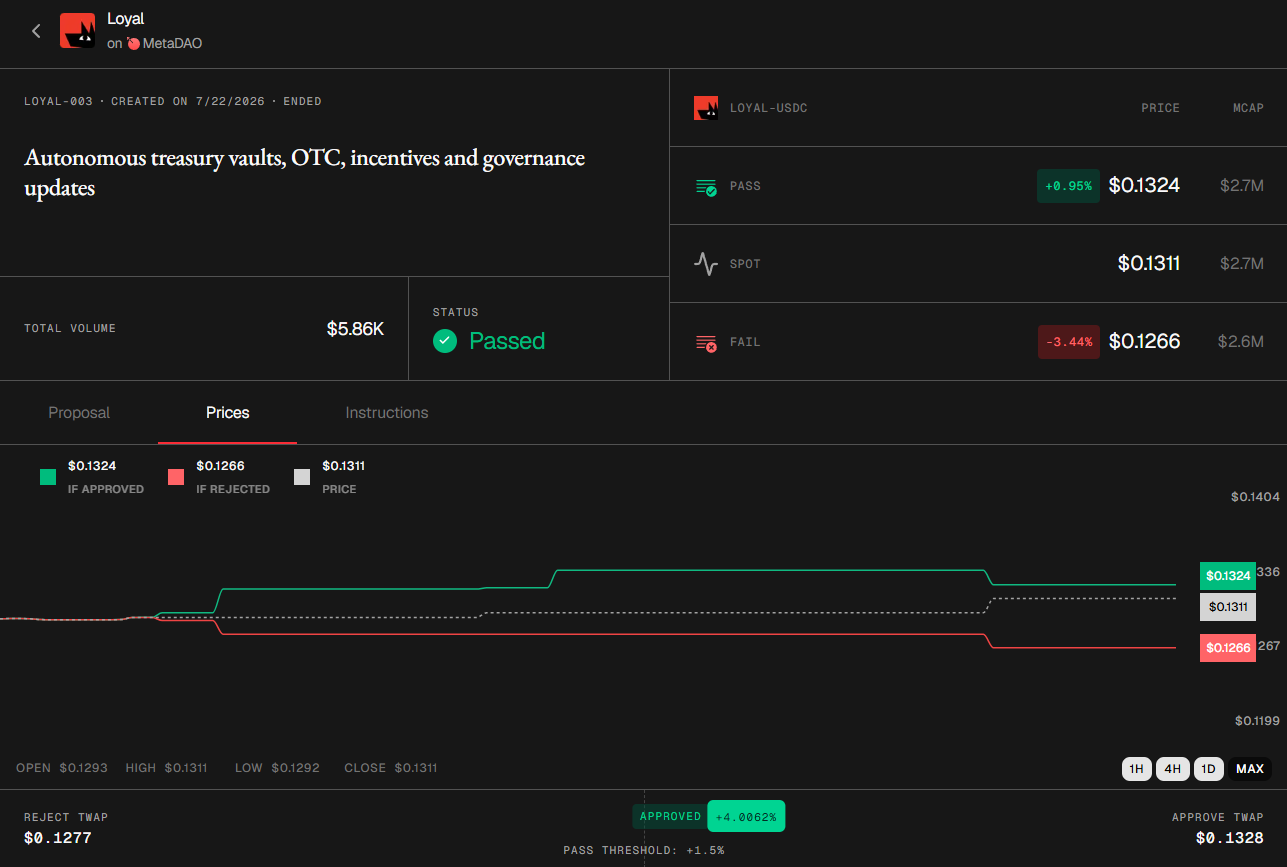
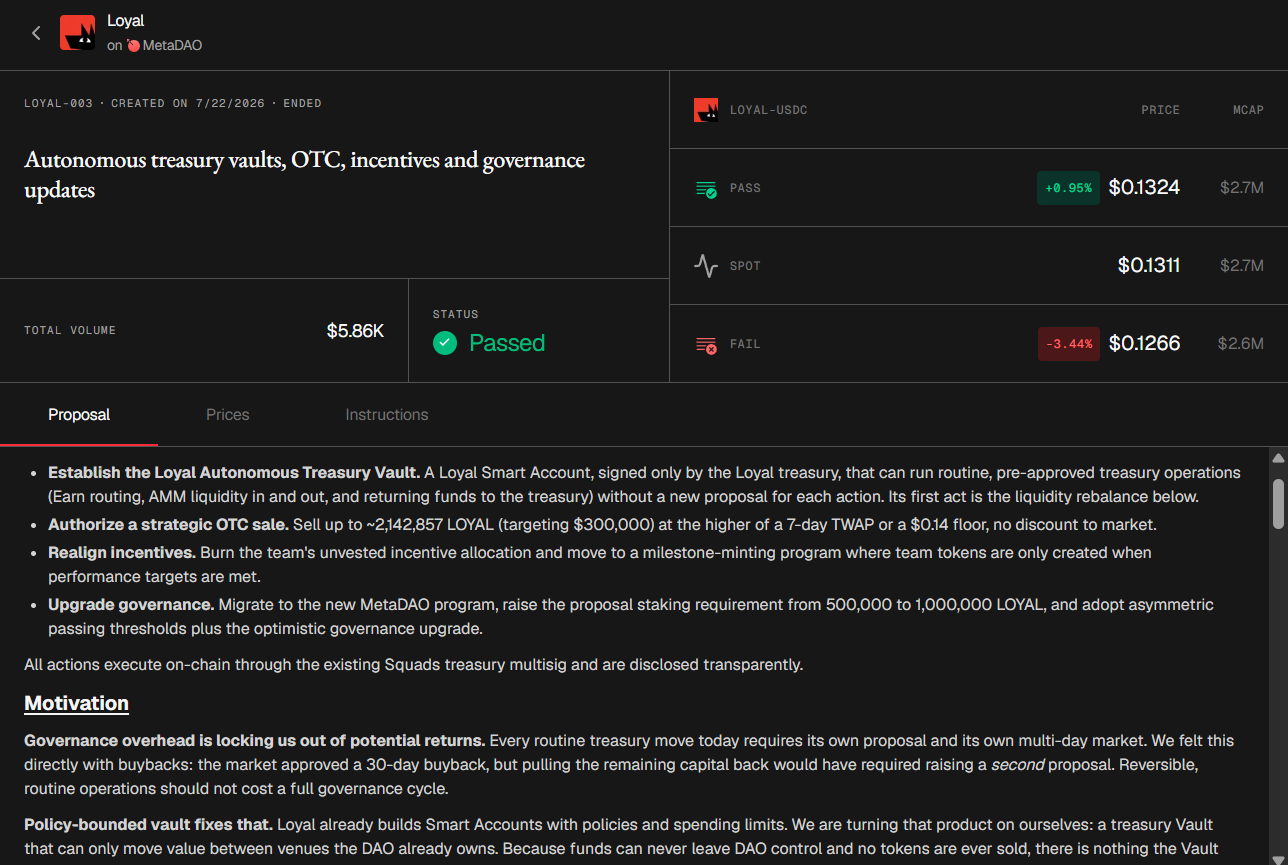
MetaDAO's docs are blunt on what this does and doesn't mean. No legal document says tokenholders own anything. What they have instead is a mechanism where the investors themselves, via decision markets, get to withdraw funds, replace operators, and divest assets. Legal wrappers and smart contracts keep that arrangement binding. MetaDAO's name for the result is an ownership coin. A normal token leaves the treasury, the IP, and most of the supply with the team, and holders of a bad team's token can do nothing about it. Here the team works for the price or the market removes them.
The treasury also gives the token something most of crypto never had, a measurable floor. Divide what the treasury holds by the tokens outstanding and you get a net asset value, NAV, per token. And because liquidation is just another proposal, that number is enforceable: trade far enough below it and any holder can move to wind the project up and have the treasury paid back out, pro rata.
The team's incentives are also aligned with the token's success. Their token package, when they take one, splits into 5 tranches unlocking at 2x, 4x, 8x, 16x, and 32x of the ICO price, each behind a minimum of 18 months. Vest on the price you deliver to your buyers and a high launch valuation is a tax on yourself, so teams underprice, the opposite of a decade of launches optimised for the highest FDV the market would bear. The treasury even seeds the liquidity pools to buy tokens back below the ICO price and sell above it, a mechanical floor under the launch.
Devansh Mehta went through every proposal ever traded on the platform, 40 at the time, and two patterns from his notes belong here. The first is that passing is genuinely hard, including for the team, the opposite of DAOs that rubber-stamp whatever the labs entity wants. One concession exists: since the omnibus update, official-team proposals pass even at a forecast 3% price drop, while outsiders still need +3%. The second is what happened every time professional money asked for a discount:
| Offer | Terms | Market verdict |
|---|---|---|
| DBA & Variant, OTC | META at a discount to spot | Rejected |
| Theia, OTC | META at a discount to spot | Rejected |
| Theia, second attempt | META at a 38% premium to spot | Accepted |
| Omnipair sale to Theia | OMFG at a 40% premium to spot | Accepted |
Insiders can't vote themselves cheap tokens, so the way in at size is above spot, through the front door.
The mechanism was also debugged by its own failures. mtnCapital, the first ICO on the platform, raised $5.7m in April 2025, back when opening a proposal required about $150k of locked capital, which nearly strangled governance at birth. Borrowing spot liquidity into proposal markets was the fix that came out of it. Then the fund underperformed, holders proposed unwinding it in September, the market agreed, and the capital went back pro rata. The first real receipt on the whole system is the machine deciding against its own operators.
BONK's Exploit
On July 6 this year, BonkDAO lost about $20m to a single governance proposal. Nobody hacked anything on the code side; the attacker used the voting system exactly as built.
- Over several days, he accumulated ~$4.4m USD of BONK on open market, a little over 1% of supply.
- He submitted a proposal to send treasury funds to his own wallet.
- 7 wallets voted. His made up 99.878% of the votes cast. Quorum required 879.95B tokens; the vote closed at 882.38B, his stake alone almost exactly enough.
- With no timelock or execution delay, about 4.4T BONK, roughly $20m, left the treasury the moment the vote closed.
- 9 hours later, $188k of the drained funds hit an exchange; the remaining ~$19m went into a multisig. Barely an hour after the drain, he had also begun dumping the attack stake itself, offloading about $5.3m worth.
The arithmetic: about $4.4m spent, about $5.3m recovered selling the stake, about $20m taken. Net profit, roughly $20m, for one proposal and 7 votes.
The system performed as designed, which is the whole problem. Token voting assumes the biggest holders have the most to lose from bad decisions. An attacker doesn't: with enough money he buys the token as a weapon, uses it once, and discards it.
The Attack Surface
BonkDAO's attack cost $4.4m and worked. How does the same play fare under futarchy? Last week, I got an answer, at Umbra, a privacy project launched on MetaDAO, and its decision market.
A wallet with no history appeared on July 27, funded through a bridge from 2 Base wallets. Over 4 days it bought 509k UMBRA for about $143k, trimmed the position to exactly the 500k tokens needed to open a proposal, then proposed moving $1.57m out of the DAO's treasury, about 62% of everything the treasury held.
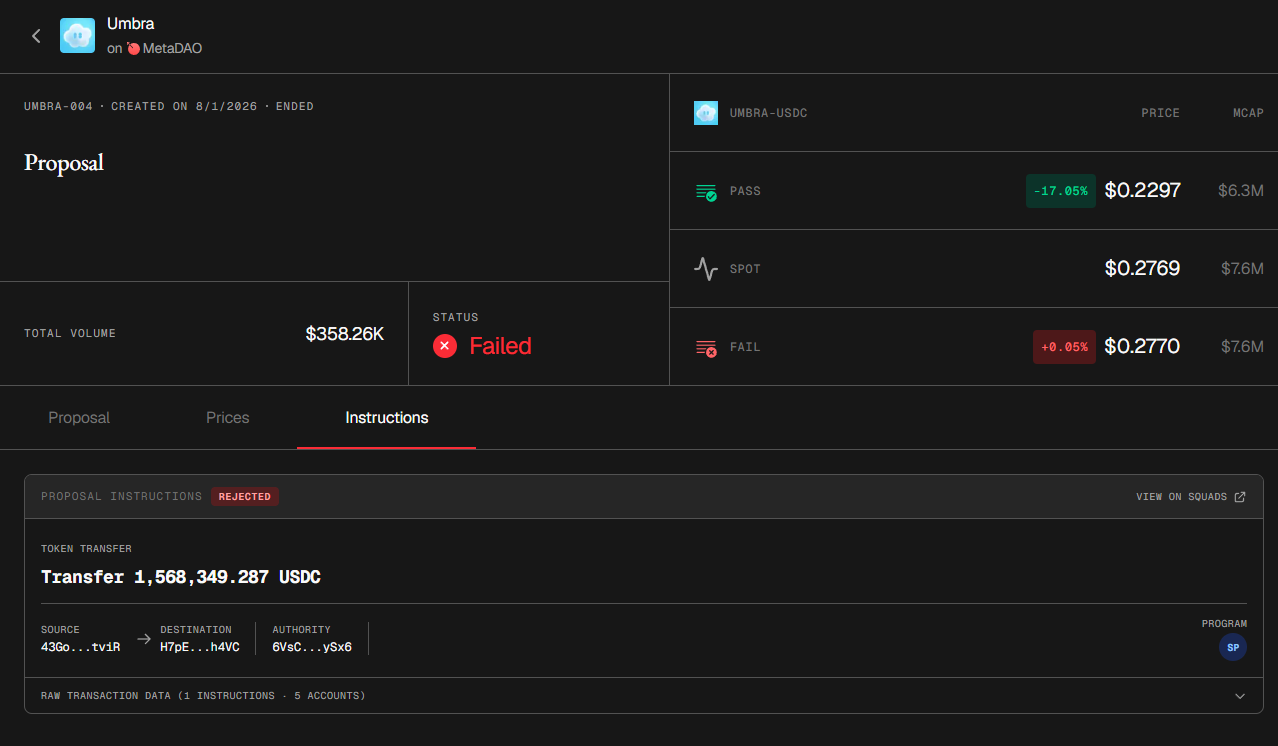
To follow what happened next, recall the setup: during a proposal, two versions of the token trade side by side, UMBRA-if-this-passes and UMBRA-if-this-fails, and the proposal passes only if the pass version averages at least 3% above the fail version over the window. An attacker therefore wants the pass price high and the fail price low. Conditional markets make attempting this cheap, because trades in the world that doesn't arrive are unwound: lose the vote and your pass-side buys are refunded, win it and your fail-side sales are refunded, and you've taken the treasury anyway.
So he worked both sides.
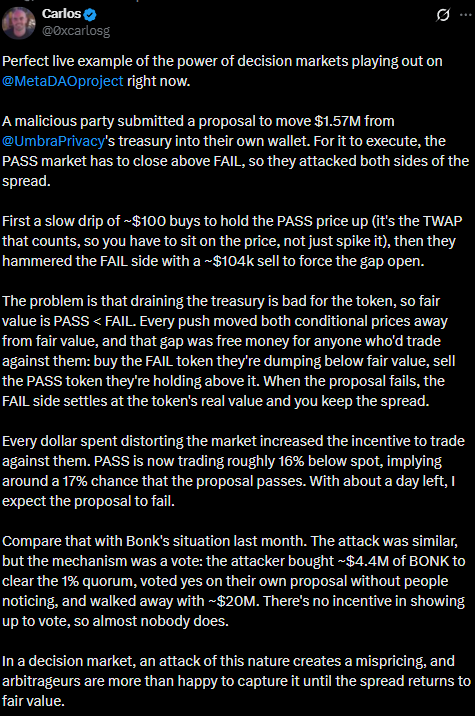
- Pass side: 40 buys of exactly $100, one per minute, a steady drip to hold the price up.
- Fail side: he sold the 500k-token stake itself across 4 sales, the largest, 399k tokens, landing 9 minutes into the resolution window. It crushed the fail price and briefly put pass 12.5% above fail. On paper, the proposal was passing.
- The defence arrived 15 minutes later: one trader sold $86k of pass exposure, a direct bet against the proposal passing. The spread flipped and never came back.
- Final: failed by 19.55 points against the +3% threshold, on $358k of volume across 255 trades from 20 wallets. 4 wallets carried about $165k of the opposition.
- The attacker's round trip cost him $4,623.
Had it passed, he would have lost about $2,463 on his trades and taken $1.57m from the treasury. The conditional pools held $52k between them, which is why moving the price was that cheap. Defence has the structural edge, because defending pays: you're selling overpriced pass exposure to someone who has to keep buying it. Still, the defence this time was 4 wallets showing up over a weekend, and the fixes 01Resolved proposes, stake locked for the duration, thresholds scaled to the share of treasury requested, deeper pools, aren't standard yet. Where BonkDAO's voters had nothing at stake, Umbra's defence came from traders risking their own money on being right, and that was enough to stop the attack.
Ranger Finance: A Case Study
Umbra showed how decision markets' mechanisms could stop outsider governance attacks. What if the team themselves happened to be malicious, or if insiders wanted to benefit? Ranger is where something like that happened. Ranger ran its ICO in January at $0.60 and raised $6m, the platform's first launch carrying prior investors and obligations. Within weeks traders were checking the team's claimed traction against on-chain data and finding it overstated, and by early March a group of holders proposed liquidation for misrepresentation before the fundraise. It passed. 9 weeks after listing, $5,047,250 went back to holders, $0.84 on every dollar raised, with holders still at the March snapshot estimated to get $0.75 to $0.82 per token against the $0.60 ICO price. Under the old playbook this story runs for years, roadmap, rebrand, dying Discord, and ends at zero. Under MetaDAO's decision markets, the project was sunset and the money returned to investors.
Why It Works
Futarchy was built to fix governance in democracies. But the best case studies, and where its success currently lives, are in the governance of ownership tokens in crypto. The elegance is that decision markets and ownership coins can solve the largest problem in crypto as an asset class today: the token-equity issue.
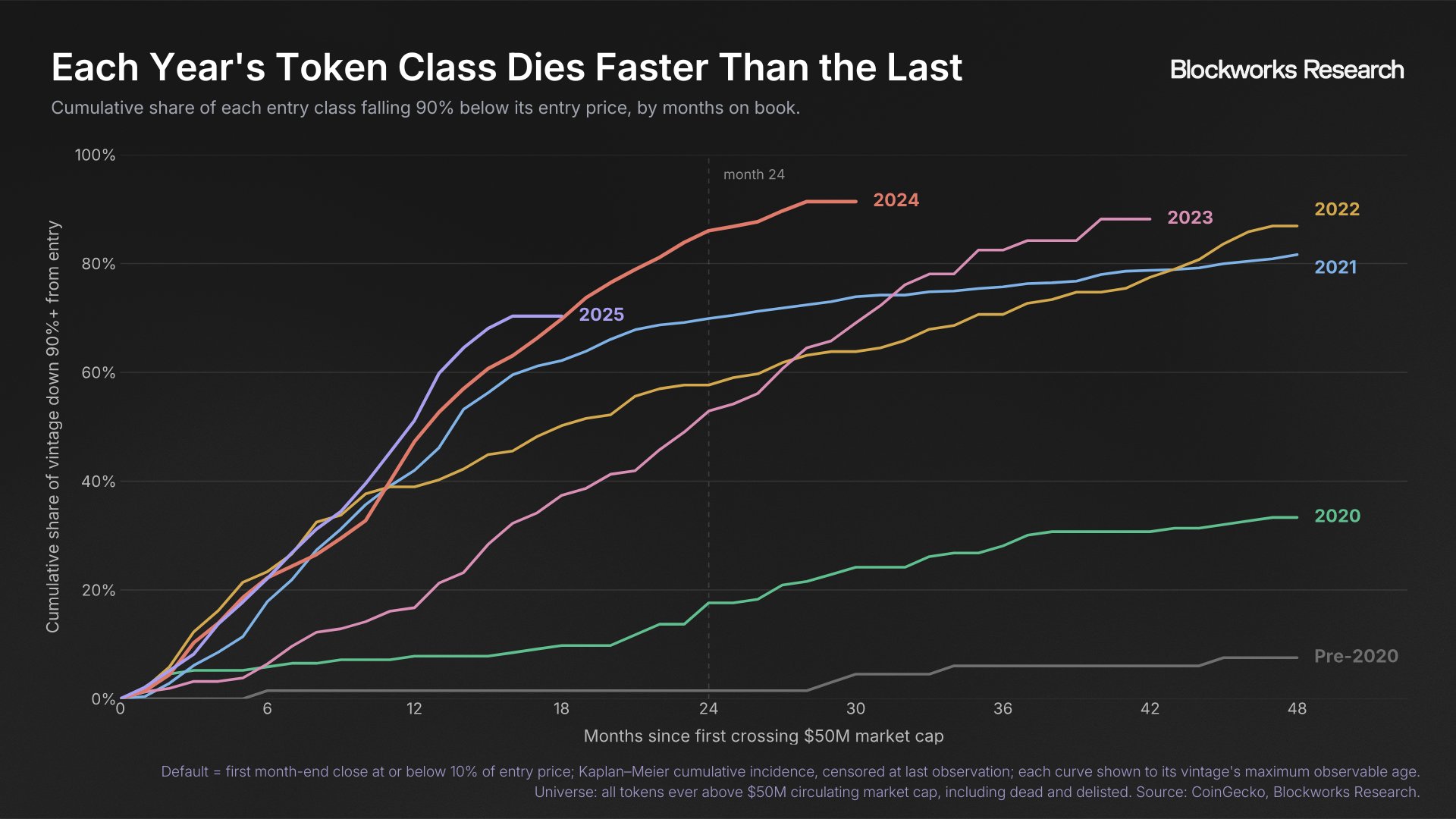
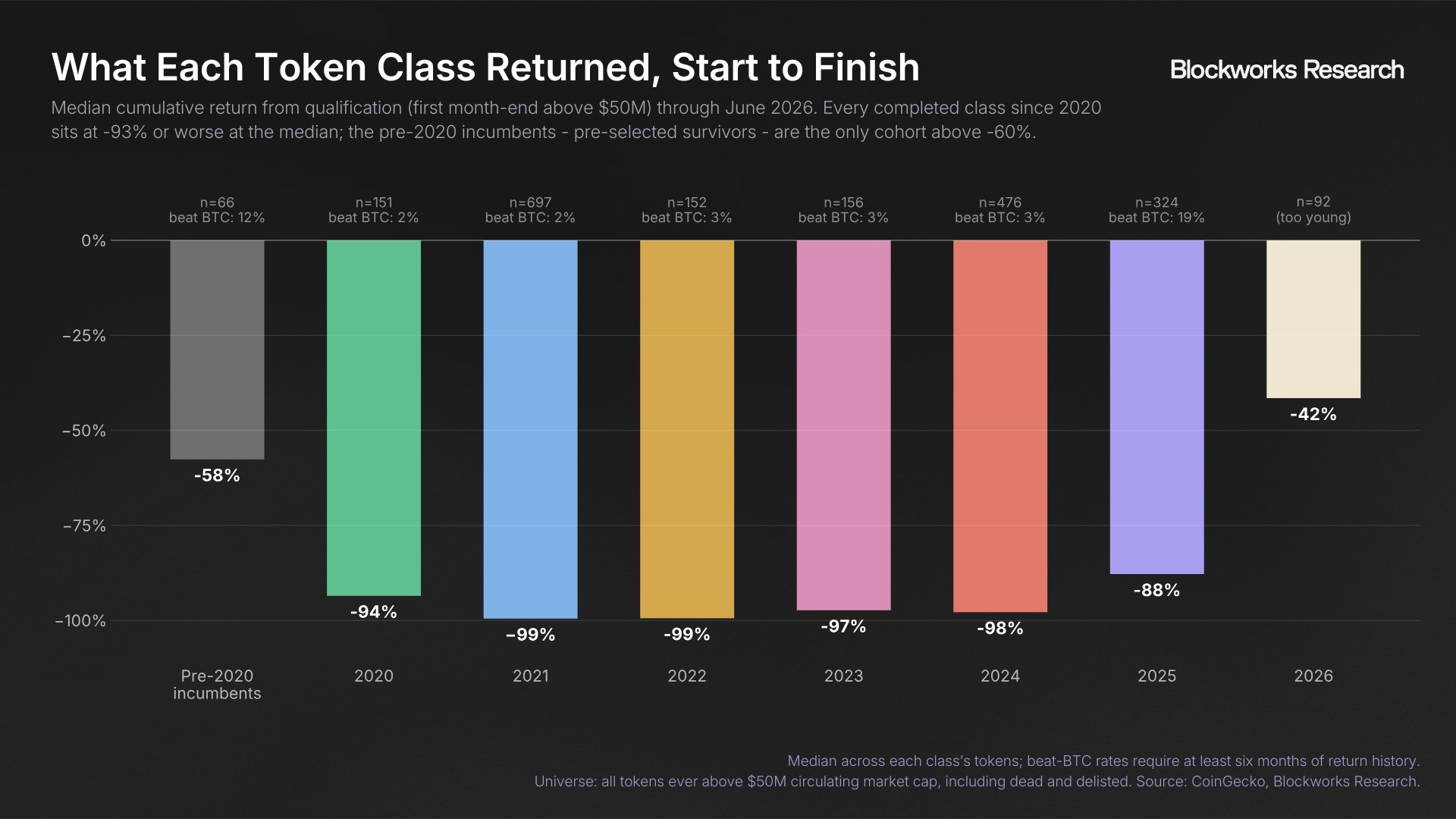
An ordinary token in crypto, beyond proof-of-work coins, often entitles holders to nothing beyond speculative value. The product doesn't need it, and the companies running crypto projects often have their own equity structure and payoffs separate from the token itself, due to securities laws. Crypto tokens and their prices inevitably drift toward zero while supply vests and unlocks from investors and teams, and holding any crypto project long-term has historically been -EV. Initial coin offerings (ICOs), from around 2014, failed on exactly this promise: utility tokens conferred nothing, and the space devolved into an asset class that primarily thrives off speculation, grifts, and financial nihilism.
Blockworks Research charted the cohorts: every completed token class since 2020 sits at -93% or worse at the median return, and each year's class hits a 90% drawdown faster than the one before it.
MetaDAO's ownership structure is the solution to this problem. A reply I saw on X put it best: decision markets encode fiduciary duty into the token without making it an equity.
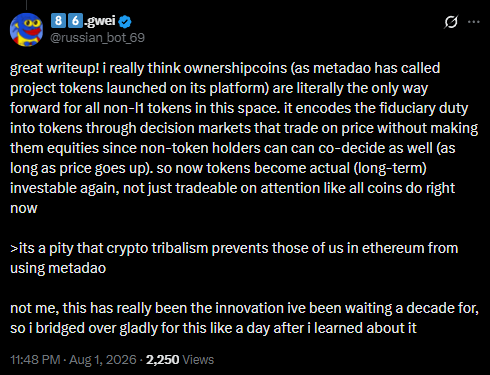
Companies enforce that duty through courts, slowly and expensively; here a standing market enforces it, and anyone, holder or not, can trade against a team. Damage the value of what the owners hold and a stranger with a thesis can propose your liquidation and profit from being right, which is exactly what happened to Ranger.
That's the whole thesis, and why I'd call the design elegant. A court enforces the duty, a board makes the decisions, an underwriter prices the round; now, a conditional decision market does all three jobs. It also makes analysis possible for the first time - a model of an ordinary token is built on levers the team can pull whenever it likes, so you can be right about the business and wrong about the token. In contrast, ownership coins provide the analyst information on the balance sheet (treasury value), the operations data, and the record of decision market/governance of the project. From the balance sheet comes NAV per token, which sets a fair value, an invisible floor price, for the token. Should a project trade below it for long enough, a liquidation proposal by investors becomes rational, and Ranger is an example of investors taking that step to reduce their downside and liquidate.
Adding all of this up, you get a positive asymmetric payoff profile that tokens never had. You have downside that is truncated by the NAV floor, while retaining liquid venture capital upside. Futarchy itself, as a governance mechanism, manages to tie in tokens to its equity value for the very first time.
So the downside is solved. The upside, liquid and venture-sized, raises different questions: why are returns like that locked inside private funds in the first place? And can this be applied to other markets? My broadest and most contrarian take is that should MetaDAO execute it right, it will not only shift the crypto token class towards legitimacy, but it will also redefine venture capitalist investing in the future.
Capital That No Longer Fits
The arguments in this section are synthesized from, and belong to, lbolord on Twitter, who is an investor in MetaDAO. It starts from the structure of the fund itself. Nearly every fund charges 2/20, a 2% annual management fee plus 20% of profits, so funds can't compete on price and compete on volume instead: perform well and the reward is a bigger fund that must be deployed in bigger cheques at higher ownership targets. Hence 700+ seed rounds of $10m or more in 2025, chasing AI companies that barely need the money; Midjourney runs around $200m of revenue on no outside funding, Cursor around $500m on under 50 people. The model will keep writing the $100m+ seed, since outcomes potentially worth trillions justify it. It cannot serve the long tail, though: the solo dev who wants a small round fast, at a low valuation, without giving up much ownership.
MetaDAO ICOs are built for exactly that long tail, and the ownership-coin structure is what makes the entry price work: teams underprice their own launches, since their tokens vest on the price they deliver, and everyone pays the same low valuation. S-tier, AI-native solo devs raise $100k to $250k at internet speed, and investors watch the product iterate in real time. Reality TV for startups, more entertaining the way live sports are with money on the line. The payoffs cover every branch:
- If it dies: the treasury returns to holders. A partial recovery and a write-off, instead of a zero.
- If it works: the startup re-raises, VCs can take the follow-on, and retail entered lower than any fund did.
- If it gets acqui-hired, likely a common ending for this generation of AI startups: holders still get paid.
- At any point: the market is liquid. Sell the moment you stop liking what you see.
The standard objection is why anyone would want non-venture-scale outcomes. The goalpost moved, though, and priors didn't: a VC entering at a $50m-$100m valuation needs a $10B+ exit, while a $100m or $1B outcome from a low entry still returns 10x to 100x, and there are far more of them. AI will likely produce an explosion of $10m-$50m ARR companies that sit below the venture frame entirely. Ownership-coin launches let the public buy those companies early and cheaply, which no fund structure ever offered, and the funds themselves, when they want size, pay over spot.
The Metrics
MetaDAO's own revenue comes from the machinery: every trade in the Futarchy AMM pays a 0.5% fee, originally split with launching teams and renegotiated to full accrual to the MetaDAO treasury on December 28. Each launch also seeds a permanent liquidity position. The AMM did about $2.4m of revenue in its first 3 months, and 01Resolved estimates roughly $130k for a quiet June.
June decision-market volume was $1.42m, up 1,675% on May. Unique wallets went from 48 to 200, 7 proposals resolved, and 12 tracked projects held $28.8m in combined treasuries at month end.
MetaDAO itself stays curated, and vetting applicants one by one doesn't scale, so the team also runs Futard.io, a permissionless sibling launchpad where anyone can launch an ownership-coin ICO in minutes. The protections and same mechanics carry over: funds sit in escrow with on-chain monthly spending limits, the raise refunds in full if it misses its goal, and governance runs on the same decision markets. One July raise on it drew about $32m in commitments against a $250k minimum. There is a social layer underneath these numbers too, and it borders on cult-like support: the community's own mascot memecoin, FUTARDIO, targeted $50k and drew $11.4m in commitments, a 228x oversubscription. That kind of support does not show up in a treasury dashboard, but it is the thing that keeps thin markets defended and new launches funded.
Adoption of decision markets outside of MetaDAO exists as well: Jito used decision markets for its fee switch, Sanctum runs all its governance on them, and Aerodrome on Base uses them for incentive allocation.
All of this is still early. Decision markets remain thinly traded, governance attacks are mitigated rather than solved, and META itself trades at a steep premium to its treasury value, around $3.05 against a NAV near $0.45. MetaDAO is an experiment in progress, not a proven success.
A prediction market gives you one number, the probability of an event. A decision market evolves from it: two prices, one for each outcome of a decision, with the spread between them as the market's estimate of what the decision is worth. Hayek argued that prices aggregate knowledge better than any planner. Decision markets extend that to decisions themselves.
The Price of Truth ended with a definition: the price of truth is the cost of being wrong, and markets stay honest because they collect it. Futarchy applies that cost to malicious governance. Under token voting, BonkDAO's attacker paid nothing to be wrong with other people's money, and $4.4m rented a $20m treasury. Under decision markets, Umbra's attacker lost money, and the traders who bet against him were paid.
Decision markets and ownership coins are one of the best and most novel experiments I have seen so far in the crypto space. If executed properly, MetaDAO stands a chance of being what I call a 0 to 1 value creation moment.
In a land full of rugpulls, industrial extraction, grifts, governance systems producing BonkDAOs, and a token landscape filled with traders primarily speculating short-term, many are still focused on optimizing crypto and onboarding retail the wrong way. I do not believe that the current launchpad mechanics of competitors, or trying to re-run the same game with memecoins, are the right way forward.
Rather, I believe that, for the very first time, there is a positive-sum outcome for participants (venture, liquid investors, builders) alike, and MetaDAO is one of the most asymmetric and +EV opportunities that I have spotted today.
Futardio.