memo-003: iron and blood

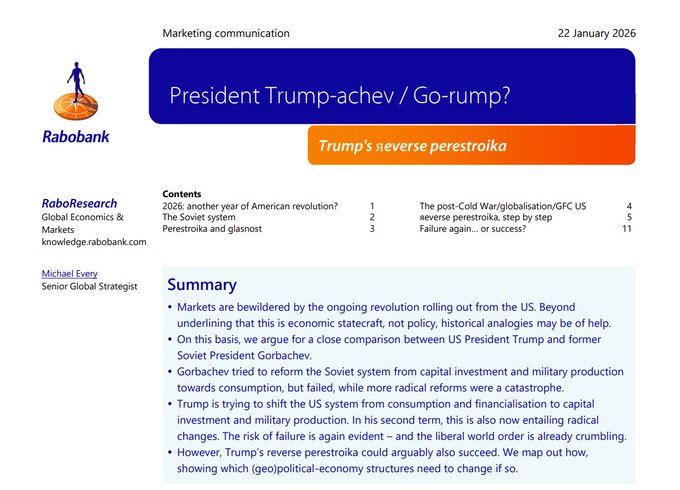
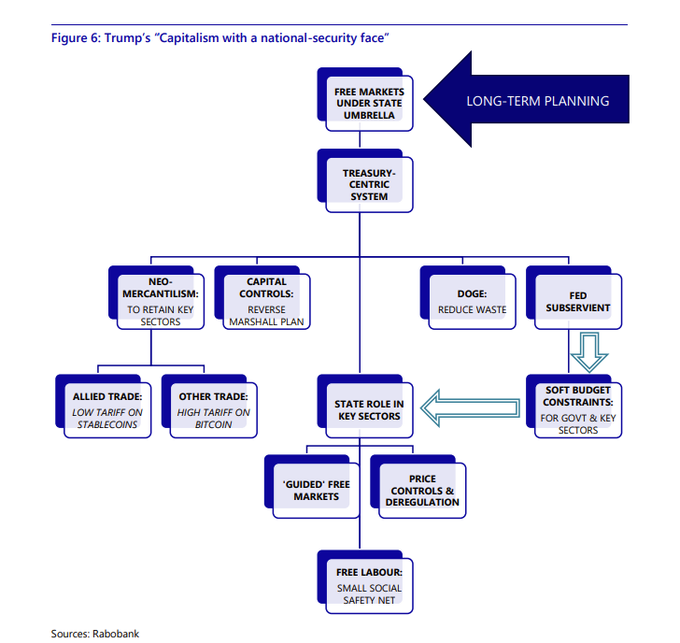
The Reverse Perestroika thesis draws from Michael Every’s work at Rabobank. Oil market analysis via Alexander Stahel at The Commodity Compass, Alexander Campbell at Campbell Ramble, and Polymarket’s interview with CRUDEOIL231. Singapore’s position quoted from Vivian Balakrishnan’s Reuters interview. The Weimar historical section draws heavily from Celina101’s ‘The Rot That Bred the Reich’, Adam Fergusson’s When Money Dies, and Mel Gordon’s Voluptuous Panic: The Erotic World of Weimar Berlin.
Some updates on forecasts and takes I built in the first two memos. I stand by most of what I wrote. The only thing that needs changing is positioning around equity and commodities, due to the risk levels in the market right now. But let me first outline some of the trends that are materialising today.
Oil, Agriculture, Physical Reality
My belief continues to be that Trump and the US are running a high-level national strategy that looks a lot like the Reverse Perestroika thesis Rabobank laid out in January. The execution of that strategy is subject to American competence, and Trump himself — while directionally correct on the diagnosis — is probably the worst possible person to be running the playbook. He alienates allies, creates chaos in Asia, and in doing so generates the supply shocks that end up landing on American households as rising cost of living.
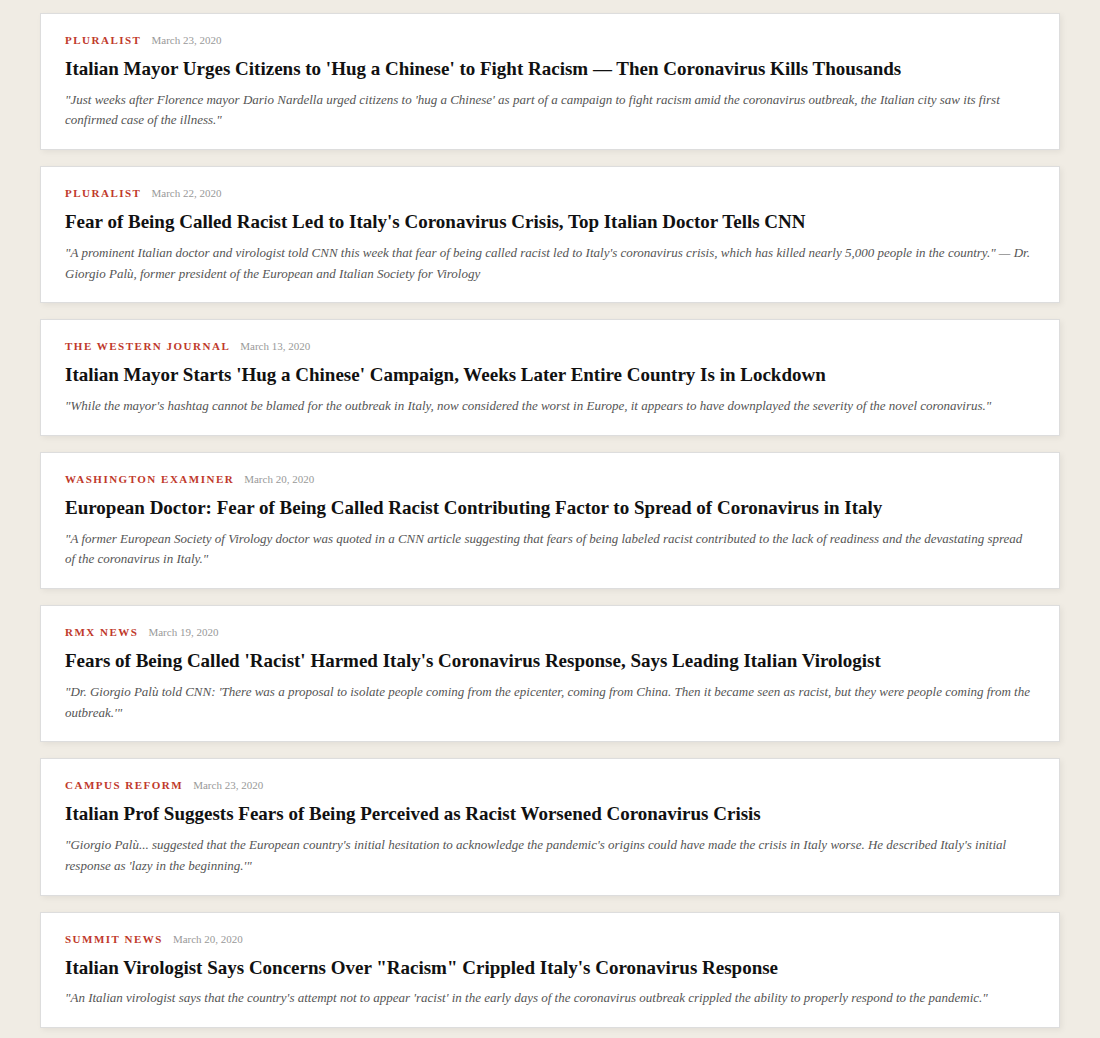
The market is walking on air right now. Equities are underpricing what is actually happening in Hormuz. This feels eerily like February 2020 before COVID — a ceasefire headline rally, everyone very keen to believe the worst is behind us, and no visible pricing of damage that has already happened. Back then the media was running “hug a Chinese” campaigns in Italian cities while Italian virologists were begging governments to shut the borders, while countries like Singapore were advocating for how there was no need to panic and wear masks. Same pattern now, different costumes.

Regardless of any ceasefire, regardless of any “cooperation with the Iranian armed forces” language about re-opening the strait, the damage to the supply chain is already done. The barrels that did not get produced did not get produced. The LNG trains destroyed at Ras Laffan take three to five years to rebuild. The Saudi East-West pipeline is damaged. Emirates Global Aluminium’s smelter cells solidify if you lose power long enough, and that production does not come back for 12 to 18 months. You cannot un-ring these bells.
The piece most generalists miss is the marginal barrel. Oil clears at the margin, not on average supply. Lose 5% of supply and the remaining chairs do not become 5% more valuable — price goes vertical because 5 people get nothing. Alexander Stahel at The Commodity Compass calls it musical chairs. OPEC’s “spare capacity” that the sell-side keeps comforting themselves with is trapped inside the conflict zone, so the 4 to 6 mbpd buffer that exists on paper does not exist in practice. Meanwhile the oil curve has been in deep backwardation, which is not just a price signal but a physical process that drains inventories every day the crisis runs. Peace on day 14 of the ceasefire starts from a worse inventory position than peace on day 1, even with zero additional damage.
The anonymous oil PM, CrudeOil231, interviewed by Polymarket put the political side of this more bluntly. If Iran controls the strait, they become “the most powerful and unrivaled swing producer in history” — a more existential threat to Saudi and the UAE than any missile or drone. The GCC states know this. They will not accept the deal shape as currently negotiated, and the lever they have is inaction: they simply maintain “partial production cuts” on the grounds that they cannot restart while Iran controls the chokepoint, which keeps oil prices elevated and drags the US back into a military solution on its own. That is how this ceasefire unwinds, and it does not require anyone to fire a shot to unwind it.
Campbell of ex-Bridgewater, who caught the silver trade, wrote this: diplomats negotiate in days, markets price in weeks, infrastructure operates on years. The curve is pricing resolution but not recovery. Everyone rallying the tape on ceasefire headlines is trading a timeline that does not exist.
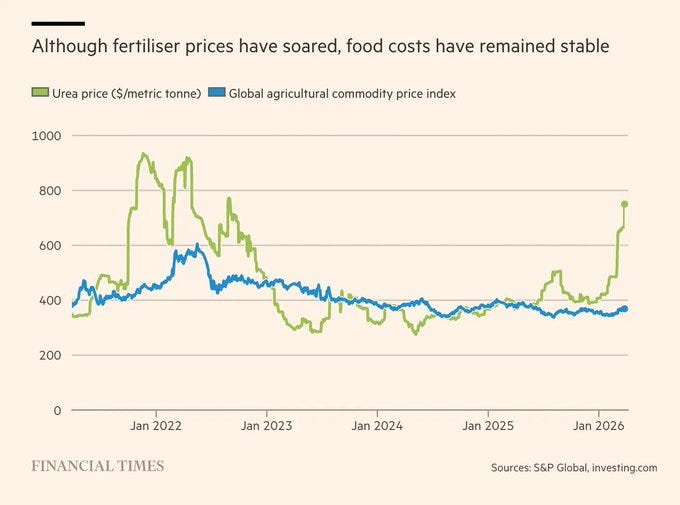
Then the second-order effects. Agriculture is the one I am most focused on. Fertiliser prices are already elevated and farmers who could not afford inputs in March are not retroactively applying them in April because diplomats shook hands. The USDA’s planned wheat crop is the smallest since 1919. Urea is still at $700. Vivian Balakrishnan said this on Reuters back in March — he specifically referenced Sri Lanka’s 2021 fertiliser ban and the yield collapse that followed as the kind of thing to watch for. That warning has not been priced anywhere I can see.
Natural gas is another issue. Europe rebuilt its supply around LNG after cutting Russia, but domestic EU production has collapsed 80% from peak. They entered this crisis drawing storage faster than seasonal norms. By autumn they are looking at another 2022. By winter, probably worse. Data centres need power, power needs gas, so there is no meaningful AI buildout at current economics in Europe or Asia until the energy picture changes. The one bright spot in this whole mess is that it is massively bullish for US domestic gas and LNG exports — the spread between Henry Hub and international LNG is the widest structural advantage US producers have had since the shale revolution.
Lastly, the refining layer. Japan imports 92% of its crude from the Middle East. These are heavy-sour barrels. Substitute them with WTI Midland and diesel output drops roughly 30% because refinery configurations do not care about your headline supply numbers but rather the crude slate they were built for. Korea, Taiwan, Singapore, Australia all have the same exposure. Australia imports 90% of its 1.1 mbpd of product demand from regional hubs after shutting its own refineries. If this drags on, shortages of jet fuel, diesel and naphtha in Asia become ground zero of the crisis. Today’s naphtha shortage in Japan is tomorrow’s feedstock constraint in Germany.
Vivian Balakrishnan’s opening frame is the most important one in all of this, and nobody in Western financial media has internalised it: 90% of the oil that traverses Hormuz is destined for Asia. 83% of the LNG. The military protagonists are Western versus Iran. The economic impact is predominantly Asian. The US overtook Saudi as the largest oil producer in 2016 and became a net energy exporter in 2019, which means the strategic calculus underlying Carter Doctrine enforcement of the strait has completely inverted. The guarantor no longer has a direct energy interest in the guarantee. Which is exactly why Trump is comfortable privately treating this as an Asian problem, and why Vivian said — very dryly, very diplomatically — that “the US is now a revisionist power.” Read that line carefully. That is Singapore’s foreign minister, on the record, telling Reuters that the underwriter of the post-1945 order has become its disruptor. Polite language for a very sharp knife!
One more angle that has been badly under-discussed. The GCC and Arab sovereigns were some of the biggest marginal capital providers to the AI buildout. Those commitments are getting quietly pulled and redirected into defense, into rebuilding damaged infrastructure, into energy security. That capital is not coming back to Silicon Valley, and it is one of the reasons I think SpaceX, Anthropic and OpenAI are all racing toward an IPO by year end. They are scrambling for exit liquidity before the ground shifts under their valuations. I remain of the view that AI development itself is unstoppable, but the valuations around it — when those IPOs hit — will very likely be the top signal for the equity market.
Positioning Update
All of this yap is pointless without putting my money where my mouth is.
Crypto allocation remains unchanged. Hyperliquid is still my largest notional allocation on a three-year horizon. Second priority is continuing to scale into ZEC and XMR as the privacy thesis plays out — this one I am more patient on.
Trad-fi has shifted. I rotated out of the AI value chain, which I was already wary of in memo-001 on bubble and valuation grounds, and rotated into agricultural commodities. I think agri is the most convex second-order play from this crisis. It is not something to be happy about. Food getting more expensive is bad for everyone. But the payoff skew is very attractive and positioning is less crowded than oil trading.
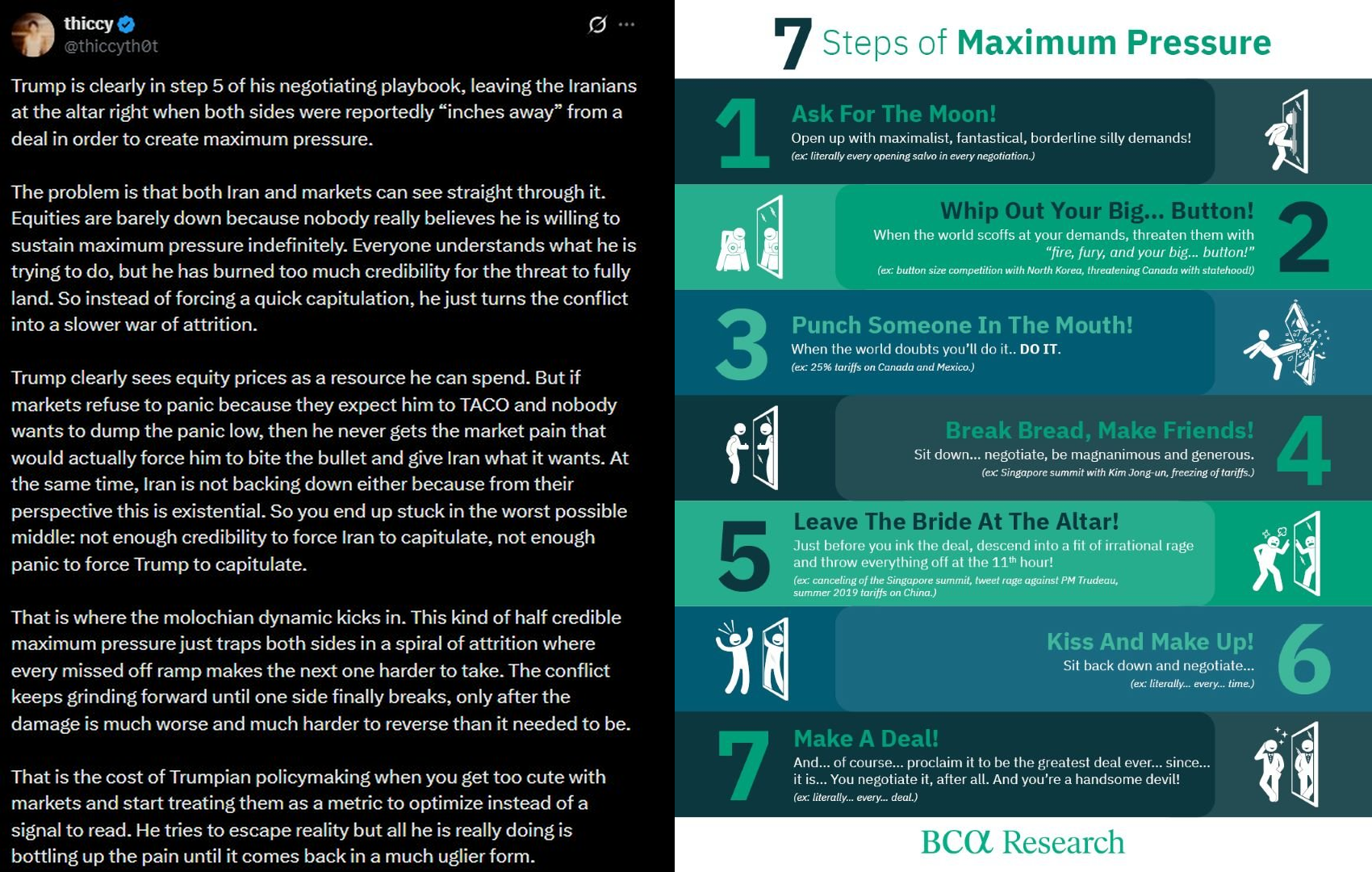
For oil, BNO and USO are my plays recently, but are tactical trades rather than long-term holdings. The rationale is closer to Thiccy’s thread — Iran and Trump keep running a negotiation-through-escalation pattern where each round of volatility suppression just builds up a bigger snapback. The market keeps trying to fade the conflict, and every time it does, the eventual re-rating gets sharper.
My drones and counter-drones thesis from memo-002 is unchanged, and if anything this crisis has accelerated it.
I derisked out of gold and copper for tactical reasons — sizing, mostly, and the need to free up allocation — but I still believe gold is the best single expression of the stagflation scenario I now think is the base case. I will rebuild on any meaningful drawdown.
On the AI value chain — memory, photonics, optical, anything tied to capex — I am now net bearish past a small relief rally on ceasefire news. The energy headwinds and the GCC capital rotation are both things the market has not absorbed yet. Stahel cites Lakshmi Sreekumar at Capital One on demand destruction math: sustained $200+ oil is the level needed to rebalance the system, which puts you in a COVID-scale recession without the policy mandates. Central banks cannot cut into that kind of inflation. QE is credibility-constrained. The AI capex cycle runs straight into that wall.
The through-line on everything: ceasefire news and peace talks are mostly a fade. The market must eventually converge to physical reality. Supply chains are broken, commodities are going higher, and stagflation is the base case for the cycle.
The financial markets being mispriced from actual, physical constraints is just one example of how many people are clinging on to some skewed version of reality that misses the entire point and theme of this decade — that moneyed interests and the ideals of international law and peace are slowly being subsumed by the coming of blood and violence. Oil, shipping lanes, refining capacity, reverse Perestroika — these cannot be well understood unless you realize that the political ground underneath is a powder keg ready to explode.
Resurgence of Extremist Thought
I wrote in memo-001 that left-wing economic populism is the theme among normie Gen-Z youth, and that the right-wing pendulum has only just begun for the rest of the Western developed world. The past few weeks reinforce both of those calls more than I expected. Both wings are rising at the same time, but they are responses to overlapping, distinct pressures, and the memo is worth more if I separate the two mechanisms cleanly.
The left-wing track. Youth and Gen-Z today, via TikTok and the demoralisation and infiltration of academia in Western institutions, have an ideology I would describe as anti-AI, anti-billionaire, anti-founder, and that blames today’s ills on some abstract form of capitalism, with white people, billionaires, Zionists and AI tech founders as a rotating basket of scapegoats. Their fears and critiques are not entirely unfounded. When you grow up in a world where the boomers are cashing out on you and all you see on TV is mass extraction from the Epstein-class politicians in the form of insider-trading and corrupt deals, entry into that camp becomes obvious.
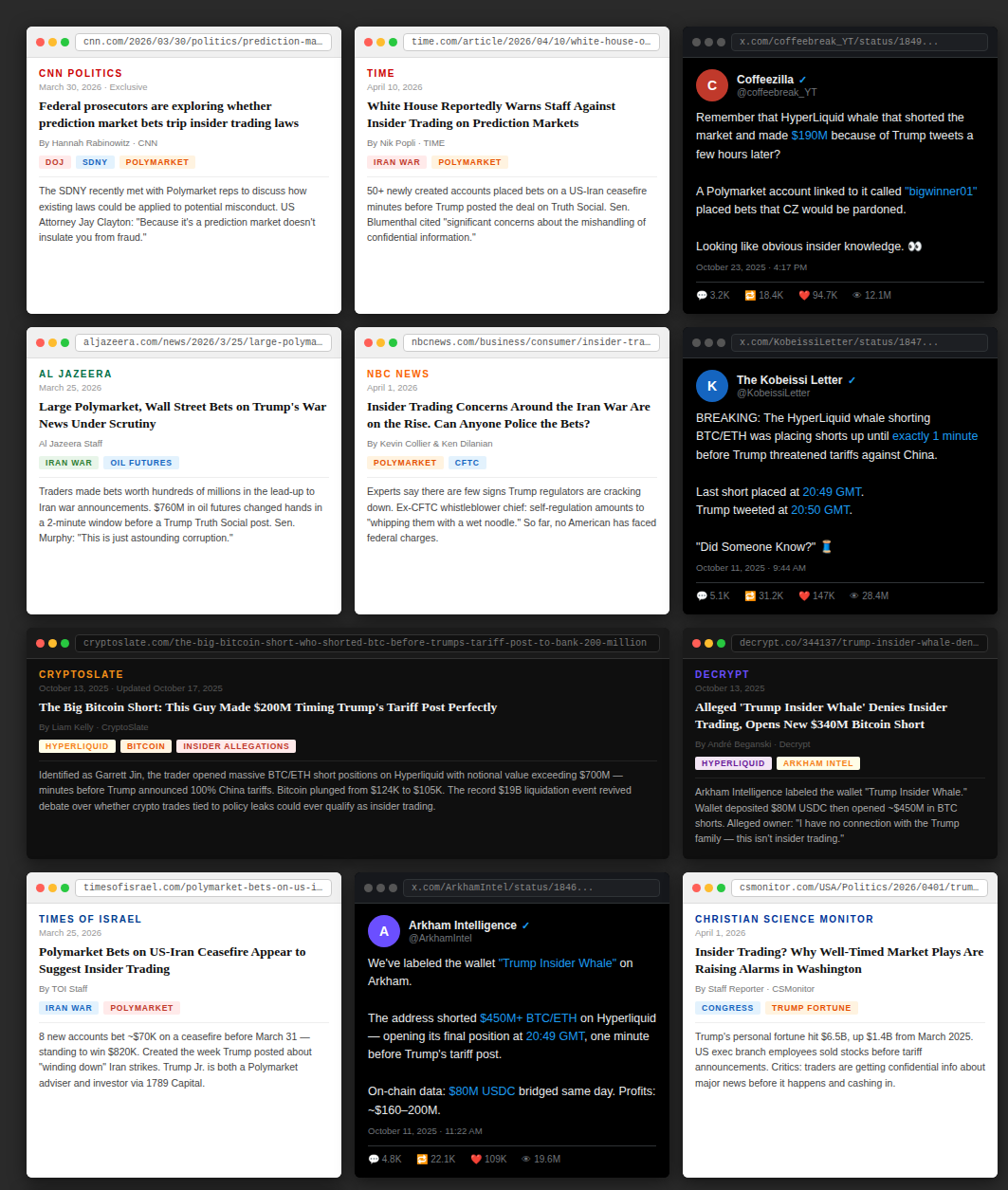
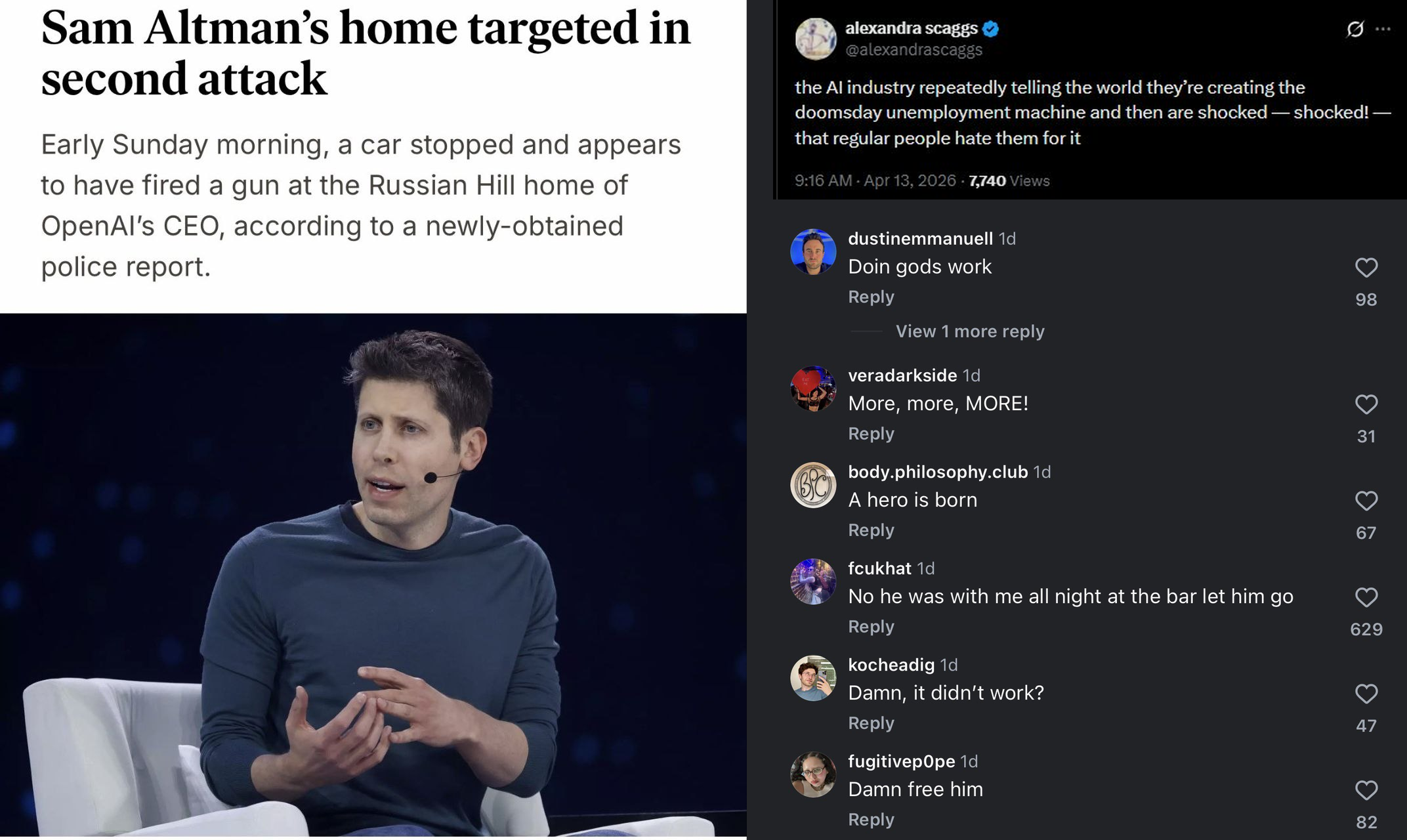
This is why Sam Altman’s home being attacked, Luigi Mangione fanboyism, and all sorts of eco-terrorism and data center sabotage happening in pockets are not surprising, and will only ramp up over the next decade. Kaczynski was the very first prototype of this in the 90s with Industrial Society and Its Future, though I doubt the crowd quoting him now has actually read his critique of the psychology and internal contradictions of modern leftism, some of which has aged like fine wine.
The right-wing track is harder to write about because the taboo is sharper, and the historical template it rhymes with is much uglier.
Most of the neo-cons today have completely abandoned the young men they supposedly speak for. Issues like immigration (legal and illegal) remain unchecked, from the US’s reliance on outsourcing to EU’s suicidal floodgates of migrants. The draft. The constant demonization in mass media and culture. The Girardian scapegoating of men as a load-bearing mechanism to keep the GDP-growthmaxxing economy running. The myth that men are still the privileged class, when they own less and less of everything that matters — equity, housing, time, their own labour. The humiliation ritual of the past decade — outsourcing on one end, AI replacement on the other — is rapidly ending, and it’s ending because people finally have something to aim their anger at.
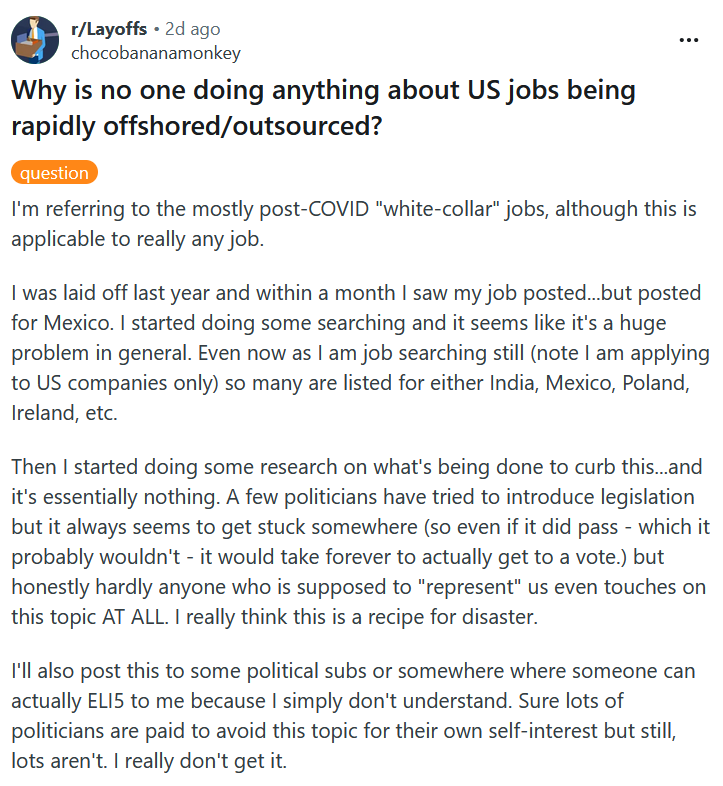
That anger gets channelled differently than the left-wing reaction. It does not attack Sam Altman’s house. It votes, it organises, and it eventually finds a figure that sweeps across the world.
The next few paragraphs draw heavily from Celina101’s ‘The Rot That Bred the Reich’, which compiles the primary source material on this better than anything else I have found.
Historical fractals are worth sitting with here. Hitler and the Nazis did not sweep Germany in one day for no reason. The hyperinflation is the part everyone remembers — savings wiped out, the middle class hollowed in months, wheelbarrows of marks for a loaf of bread. The part most history classes skip is that Weimar Berlin was also, at the same time, one of the most openly decadent and predatory cities in modern European history. The moral collapse and the material collapse arrived together, and they fed each other.
Adam Fergusson documented the mechanism cleanly in When Money Dies. When the currency dies, morality becomes an unaffordable luxury.
“A prostitute in the family was better than an infant corpse; theft was preferable to starvation; warmth was finer than honour, clothing more essential than democracy, food more needed than freedom.”— Adam Fergusson, When Money Dies
He is describing the literal mechanism by which hyperinflation destroys a society’s moral floor. You cannot eat principles.
What Berlin became on top of that material collapse is documented in terms most people now find unprintable. The German government had legalised prostitution during the final stretch of the Great War, issuing state coupons to returning soldiers so they could use approved brothels and contain venereal disease. Those same traumatised young men came home to a country that no longer had any moral objection to any of it. Hans Ostwald wrote at the time that most dance halls were “nothing but markets for prostitution.” War widows worked the streets. Schoolboys turned tricks in dim bars where, as one contemporary put it, “government officials and men of finance tenderly courted drunken sailors without any shame.” Roughly thirty separate homosexual publications were available on a typical Berlin newsstand. The underground economy had developed a precise taxonomy of vice, catalogued by police and contemporary observers.
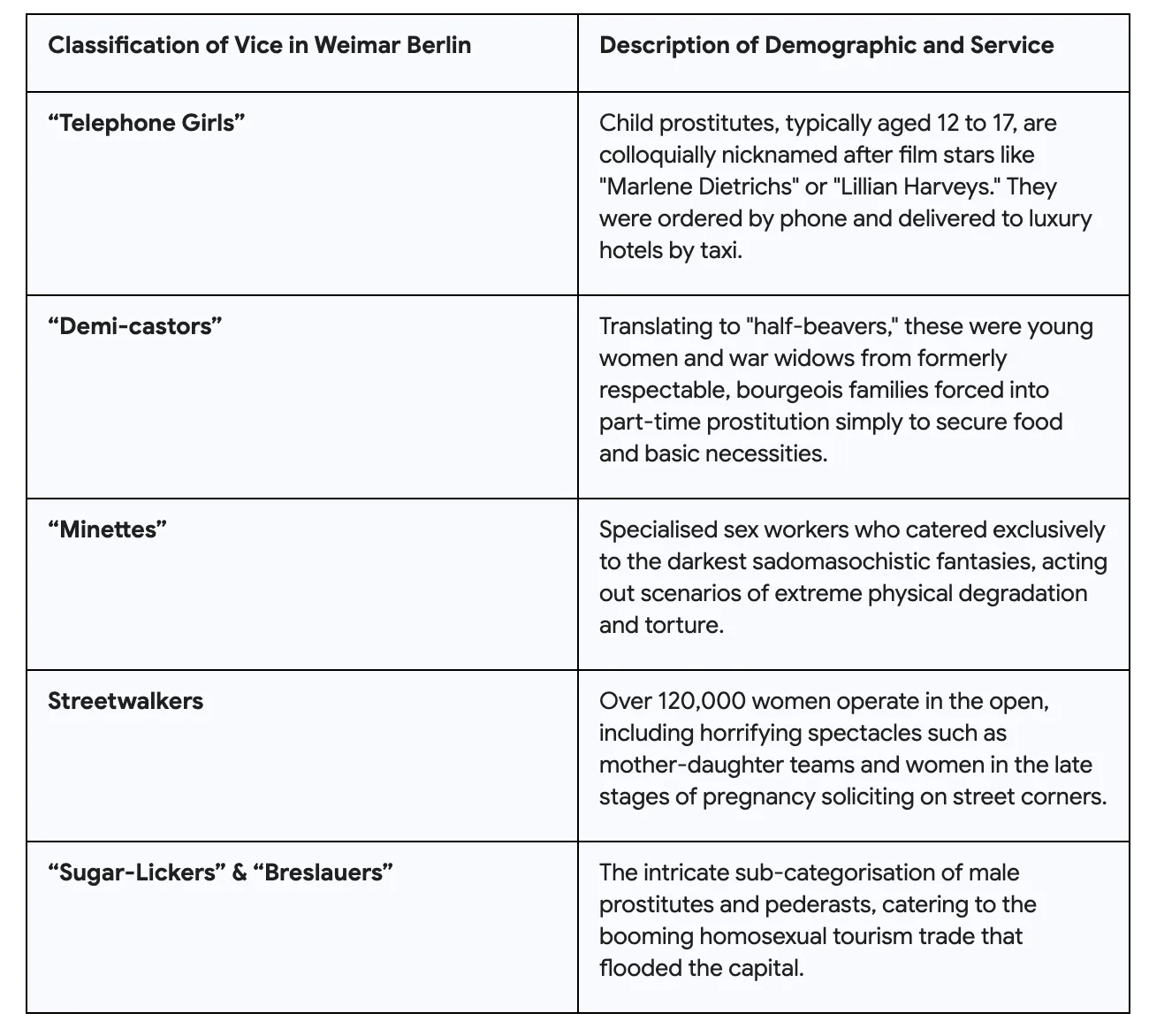
And underneath all of it was a booming, well-regulated child prostitution industry catering to any taste, provided you knew where to go. Magnus Hirschfeld — one of the architects of the era’s “sex reform” movement, ironically — himself documented the worst of it.
“In January 1932, a Berlin tabloid exposed a ‘prostitute ring’ of ten-year-old girls who worked independently at the Alex U-Bahn Station. Each girl stood demurely inside a subway entrance foyer, hoping to catch the eye of an impulsive Cavalier (heterosexual pederast) on his way to work. Astonishingly, the prepubescent girl had been engaging in sex work unimpeded for months before the story broke. Of course, all major cities had to confront this pressing and psychologically debilitating civic problem, particularly during hard times.
But in Berlin the quandary of child-prostitution was partly resolved by a more cynical and horrifying, free-market approach: the opening of child brothels. How many children were actually pressed into sexual service/slavery is unknown. Magnus Hirschfeld reported on one such lucrative operation on Alexandrienstrasse, where a ‘rapacious harem’ of 14-year-old Russian girls ‘lewdly beguiled’ wealthy Cavaliers from Berlin’s industrial elite. The house was, remarkably, shut down by the municipal court after a sensational trial shrouded in political intrigue and late-night government machinations.”— Mel Gordon, Voluptuous Panic: The Erotic World of Weimar Berlin
Hyperinflation did not only hollow the middle class domestically. It turned Berlin into the sex-tourism capital of the world. Foreigners with stable currency — an American with a single dollar, a Dutchman with a handful of guilders — could live like kings and buy the most extreme forms of degradation the city had to offer. The daughters and sons of German working-class families were being purchased at pennies on the dollar by visitors from the same countries that had just imposed the reparations regime. That sentence sits at the heart of what made the reactionary wave as total as it was. Every history of the period that sanitises this part of it fails to explain the scale of what followed.
The decadence was a top-down elite project, not organic cultural drift. Hirschfeld’s Institut für Sexualwissenschaft, founded in 1919, served as the command centre for an explicit “sex reform” movement backed by coalitions of liberal, social-democratic and communist parties, aggressively lobbying to decriminalise prostitution, abolish obscenity laws, normalise every form of sexual deviance, and push what we would now call trans ideology under the label of “sexual intermediacy.” Hirschfeld co-wrote and partially funded the 1919 silent film Anders als die Andern as direct propaganda, appearing on screen himself to deliver a lecture to the audience about why the laws needed to change. The apparatus was institutional, heavily funded, and openly hostile to the rooted working-class German who felt his country being pulled out from under him.
And then there is the part most modern histories skip past, even though it is the structural key to the whole reactionary wave. The Weimar cultural revolution was driven by a cosmopolitan urban elite that was heavily, visibly, disproportionately Jewish. This was openly discussed by Jewish intellectuals themselves long before 1933 — in 1913, the young Jewish writer Moritz Goldstein published a widely-read essay acknowledging that a Jewish intellectual class had ended up managing the cultural production of a nation that felt culturally alienated from them, and noting the dangerous friction this was generating. Weimar made that friction catastrophic. The architect of the Weimar constitution itself was Hugo Preuss. The commanding heights of Weimar cultural production — the leading publishers, the avant-garde theatres, the psychoanalytic institutes, the sex-reform clinics, the legal drafting committees, the Frankfurt School — were visibly concentrated in a class that the rural and working-class German could identify by name. The traditional German watching his daughter being sold on the street while his own language, religion and family structure were mocked by the newspapers, the theatres and the universities was not imagining the pattern. Ordinary Germans started pejoratively calling the whole thing the Judenrepublik.
I am writing this down because it is the mechanism, and because refusing to name the mechanism is how it runs again. The Nazis did not invent antisemitism but weaponised it eventually for their own interests. The lesson is not about any particular group. But the fact is this;
Extreme decadence invites an extreme, brutal correction.
This correction comes from the increasing radicalisation and behaviours of both the left and right wing.
The material conditions today are not identical but they rhyme, and so do the moral ones. A cohort that cannot afford shelter or family formation is being told their jobs are about to be automated while asset owners compound wealth from infrastructure they have no equity in.
At the same time, they watched an elite class get publicly exposed for running an industrial-scale child trafficking operation through Epstein, with almost nobody held accountable. They see OnlyFans marketed to their sisters as empowerment — the exact Weimar mechanism of economic desperation laundered as liberation.
They see an institutional apparatus — media, academia, HR, federal regulators, the NGO-industrial complex — that spent a decade lecturing them about virtue while protecting the people committing the worst of it. And they see Hirschfeld’s exact framework — elite-driven deconstruction of biological and sexual reality under the banner of “science” and “liberation” — running again on a much larger balance sheet, with better distribution.
That is what these moments look like. The left-wing track and the right-wing track are both loaded. Both are responding to real conditions. When both tracks load at the same time, what follows is historically not calm.
We are going back to an era where nations are scrambling for resources amidst a potential AI super-war in this decade. It is a world where some are now thinking in terms of iron and blood rather than spreadsheets and ideals like international law and free-trade agreements. Things look messy in the street because they ARE. For all the supposed wisdom of our leaders and older generations, I am surprised to see that they fail to recognize one important fact — the adults are no longer at the table, and violence, not money, is the upcoming new meta. Political violence requires political solutions, and there is no political solution for the upcoming volatility that is about to one-shot this generation. For the old world is dying, and the new world struggles to be born: now is the time of monsters.
“The last century [the 19th] was the winter of the West, the victory of materialism and scepticism, of socialism, parliamentarianism, and money. But in this century blood and instinct will regain their rights against the power of money and intellect. The era of individualism, liberalism and democracy, of humanitarianism and freedom, is nearing its end. The masses will accept with resignation the victory of the Caesars, the strong men, and will obey them.”— Oswald Spengler